Concept2 RowErg vs WaterRower Club 2026

Thirty years of training at home. Built multiple home gyms from bare garages to proper setups. I know what equipment lasts, what breaks, and what becomes an expensive clothes rack.
Just so you know, some links on this page are affiliate links. If you buy something via them, we get a small kickback. You don't pay more, but it helps toward the next bit of kit.
Looking for more equipment recommendations?
Browse All GuidesI earn a commission on purchases made through links on this page. Full disclosure here.
If you want one answer, here it is: for most people the Concept2 RowErg is the rower to buy. It is the machine competitive rowers, CrossFit boxes and coaches actually train on, its PM5 monitor gives you the most accurate and comparable data in the category, it splits in two for storage, and it costs less than the wooden alternative. The WaterRower Club is the right buy for a specific person: someone who wants the smooth, on-water feel of a water flywheel and a handcrafted hardwood machine that looks like furniture, and who cares more about the experience of rowing than about chasing split times. Both are genuinely excellent. They are just built for different priorities, and once you know which camp you are in, the choice makes itself. If you are not sure rowing is even your cardio, my best rowing machine guide covers the wider field first.
Quick Picks
Not sure which setup is right for you?
Take Our QuizThis is the classic rowing-machine debate, and it really does come down to air versus water. One is a performance tool; the other is an experience. Neither is a mistake.
The Concept2 RowErg: The Performance Standard
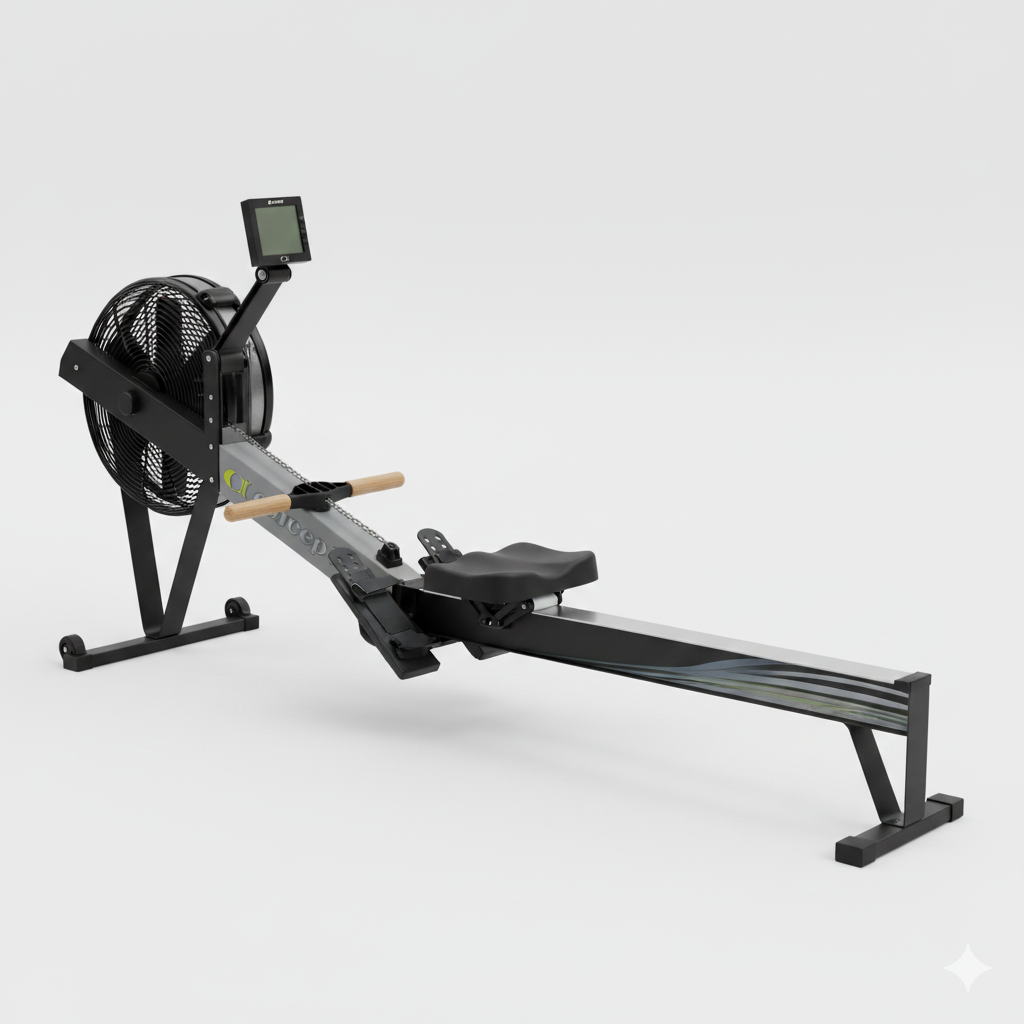
The Concept2 RowErg is the machine almost every serious rower has used at some point. It runs on air resistance: you pull a handle on a nickel-plated chain that spins a flywheel, and a damper lever lets you set how much air the flywheel catches, which changes the feel rather than simply making it harder. The actual effort always comes from how hard you pull, which is exactly why it suits everyone from a first-timer to an Olympic trialist on the same machine.
The real reason it dominates is the PM5 Performance Monitor. It gives you accurate, repeatable numbers for every stroke, splits, watts, calories and distance, and because every RowErg in the world uses the same monitor, your 2,000m time means the same thing in your spare room as it does at a competition. It connects over Bluetooth and ANT+ to 40-plus apps, so you can race other people online or follow structured workouts. For anyone who wants to track progress and actually see themselves get fitter, that data is the whole game.
It is also the practical choice. The RowErg separates into two pieces in seconds and rolls away on caster wheels, the frame is light enough to move alone, and it carries a 500-pound user capacity with a 5-year frame warranty. Parts are cheap and easy to find, the machine is close to indestructible, and there is a huge second-hand market because gyms buy them by the dozen and they simply do not wear out. The one thing it is not is beautiful. It is a functional grey-and-black tool, and the air flywheel makes a distinct whoosh that is louder than water. You buy it for what it does, not for how it looks in the living room.
Check the Concept2 RowErg on Amazon
The WaterRower Club: The Feel and the Furniture
The WaterRower Club comes at rowing from a completely different angle. Instead of air, it uses a water-filled flywheel: paddles spin inside a tank of water, and the resistance self-regulates, so the harder and faster you pull, the more the water pushes back. The result is a pull that many people describe as the closest thing to rowing on real water, smooth and progressive with no dead spots, and a soft swoosh that is quieter and more soothing than an air rower's whir.
Then there is the object itself. The Club is handcrafted in Rhode Island from solid hardwood, a design that dates back to the mid-1980s and has barely needed changing since. It is the rower you can leave out in a room without it looking like gym equipment, and it stores upright on its end in a footprint about the size of a dining chair. For a lot of buyers that is the entire appeal: a serious piece of cardio kit that reads as furniture, not as a machine you have to hide.
Where it gives ground is data and convenience. The S4 monitor covers the essentials, but it is not the competition-standard, directly-comparable benchmark the PM5 is, so if you want to race online or compare your numbers against a global standard, it is a step behind. The Club is also heavier and less portable, weighing over 100 pounds with water in the tank, and the baseline resistance is set by how much water you put in the tank rather than adjusted on the fly. None of that matters if you are rowing for fitness and feel. It matters a lot if you are rowing for a number.
Check the WaterRower Club on Amazon
Head-to-Head: Concept2 RowErg vs WaterRower Club
| Dimension | Concept2 RowErg | WaterRower Club | Winner | Why it matters |
|---|---|---|---|---|
| Performance data | PM5, competition standard | S4, essentials only | Concept2 | Comparable, trackable numbers |
| Resistance feel | Crisp air catch | Smooth on-water pull | WaterRower | The water feel wins fans |
| Storage and portability | Splits in two, light, casters | Upright but over 100 lb | Concept2 | Easier to move and stow |
| Noise | Audible air whoosh | Softer water swoosh | WaterRower | Quieter in a shared home |
| Looks | Functional grey tool | Handcrafted hardwood | WaterRower | Furniture, not gym kit |
| Durability and parts | Near-indestructible, cheap parts | Solid wood, water upkeep | Concept2 | Decades of cheap servicing |
| Resale and value | Huge used market, lower price | Premium price, holds value | Concept2 | More machine per dollar |
| Best suited to | Training and progress chasers | Feel and aesthetics seekers | Depends | The whole decision in a row |
The split is clean. The Concept2 wins everything to do with training, data, portability and value. The WaterRower wins on feel, quietness and the simple pleasure of owning a beautiful machine. There is no wrong answer here, only the right answer for what you want from a row.
Which One Should You Buy?
Buy the Concept2 RowErg if you are the type of person who wants to get measurably fitter and have the numbers to prove it. It is the only call for anyone training for performance, doing CrossFit, following structured rowing programs, or who simply wants the machine that will still be going strong in fifteen years and is easy to move and store in the meantime. For the large majority of buyers, this is the one.
Buy the WaterRower Club if the experience of rowing matters more to you than the metrics, if you want the smooth water pull and the quieter sound, and if you want a machine you are happy to leave on show because it looks like a piece of furniture. It is a genuinely lovely thing to own and use, and for the right person that pleasure is exactly what keeps them coming back to it.
Buy neither if you are not sure you will stick with rowing at all. A rower only works if you use it, and if cardio consistency is your real problem, a cheaper magnetic rower or an exercise bike is a lower-risk place to start. You can always upgrade to one of these two once the habit is real. If you are still weighing rowing against other cardio entirely, the rowing machine vs exercise bike comparison is the better starting point.
The Row, Day to Day
The two machines feel different from the very first session and keep diverging the longer you own them. On the Concept2, the early rows are about learning the damper and your stroke rate. A common beginner mistake is cranking the damper to 10 thinking higher means better, when most coaches row around 3 to 5 because it produces a cleaner, more sustainable stroke. Once you settle in, the PM5 takes over as the reason you keep going back. You start chasing a faster 2,000m, racing other people online, or working through structured intervals, and the machine quietly turns your effort into a number that climbs over the weeks. That feedback loop is what makes the Concept2 so sticky for people who like to measure progress.
By contrast, the WaterRower asks for none of that. The first rows are about finding the rhythm of the water and settling into the swoosh, and over time the appeal is exactly the absence of a nagging metric. You row because the motion is calming and the pull feels good, not because a screen is pushing you to beat yesterday. Owners often describe it as the rare piece of cardio kit they actively look forward to, and the wood ages into the room rather than dating like plastic and steel. One machine rewards the part of you that wants to compete; the other rewards the part that just wants to move and switch off. Which of those sounds more like you?
What Owners Report
I have not trained on these two side by side myself, so treat this as a synthesis of what owners and reviewers consistently say rather than a firsthand test. Concept2 owners are almost evangelical about reliability: the recurring theme is machines running perfectly after a decade of daily use, with the only maintenance being the occasional chain oiling. The PM5 data and the online racing community come up again and again as the features that keep people rowing, because progress you can measure is progress you chase. The most common gripe is simply the noise and the looks, which nobody who bought it for training seems to mind.
WaterRower owners talk about something different entirely: the feel. The water pull and the swoosh get described as calming, almost meditative, and a lot of owners say it is the first cardio machine they have actually wanted to use. The frequent caveat is the weight and the faff of the occasional water treatment tablet to keep the tank clear, plus the honest admission that the S4 monitor is basic next to a PM5. The pattern that matters most for a buying decision is consistent: almost nobody who bought the Concept2 for training regrets it, and almost nobody who bought the WaterRower for the feel regrets it either. The unhappy buyers are the ones who bought for the wrong reason, a data-chaser who picked the wood, or an aesthete stuck with the grey tool.
Setup and Upkeep
Living with each is genuinely different, and it is worth knowing before you buy. The Concept2 goes together in around twenty minutes with the tools in the box, runs its monitor on a couple of D batteries, and asks almost nothing of you afterward beyond oiling the chain now and then. When you are done it splits into two pieces and rolls away on its casters, so a small room can double as a gym and go back to normal in seconds. It is about as low-maintenance as a serious piece of equipment gets.
The WaterRower trades some of that convenience for its character. You fill the tank to your preferred level with the supplied pump when it arrives, and a couple of times a year you drop in a water-purification tablet to keep the tank clear. It stores upright on its end, which is tidy, but at over a hundred pounds with water in it, moving it between rooms or up stairs is a two-person job you will not want to repeat often. Neither machine is demanding, but the Concept2 is the one you can ignore and the WaterRower is the one you tend a little. For most buyers that upkeep is a fair price for the feel, as long as you go in expecting it. Check current availability on either before you commit, since the wooden models in particular move in and out of stock.
What to Avoid
Buying the WaterRower expecting Concept2-level data. The S4 monitor is fine for tracking your own sessions, but it is not the globally comparable benchmark the PM5 is. If you want to race online, compare against standardized times, or follow programs built around watts and splits, do not buy the wood and hope to catch up. That is exactly the mismatch that leads to regret.
Buying either one before you measure your space and your stairs. Both need roughly an 8 to 9 foot length to row in, and the WaterRower is over 100 pounds with water and awkward to carry up a flight of stairs. Plan where it lives before it arrives, not after.
Chasing a cheap no-name "water rower" to save money. The WaterRower's appeal is the build quality and the feel, and the budget imitations deliver neither, with flimsy frames and leak-prone tanks. If the water feel is what you want, buy the real thing or buy a Concept2. The middle ground is where the disappointment lives.
The Honest Case Against Each
Against the Concept2 RowErg: it is plain to look at and the air flywheel is audibly louder than water, so if you want a machine that blends into a living room or that you can use without waking the house, it is the weaker pick. It is a tool, and it never pretends to be anything else.
Against the WaterRower Club: it costs more, weighs more, and its monitor is not in the same league as the PM5 for anyone who trains by the numbers. It also needs the occasional water treatment to keep the tank clear, a small chore an air rower never asks of you. You are paying a premium for craft and feel, and if those do not move you, the money is better spent elsewhere.
What I'd Buy Today
If I were buying a rower to actually get fitter on, I'd buy the Concept2 RowErg without a second thought. It gives you the best data, the easiest storage, near-indestructible reliability and the lowest price of the two, and it is the machine you will still be using in a decade. It is the right answer for most people, and it is the one I'd set up today.
If the feel and the look are what pull you in, and you want a rower you will love owning as much as using, the WaterRower Club is a beautiful machine that earns its keep every time you sit on it. Pick the one that matches why you are buying, and then row.
As an Amazon Associate, we earn from qualifying purchases.
Products Mentioned in This Guide
Frequently Asked Questions
Related Guides
Find Your Perfect Equipment
Expert guides for racks, barbells, plates, benches, and more. Build your home gym the right way.
Browse All Guides