Best Weight Benches UK 2026

Thirty years of training at home. Built multiple home gyms from bare garages to proper setups. I know what equipment lasts, what breaks, and what becomes an expensive clothes rack.
Just so you know, some links on this page are affiliate links. If you buy something via them, we get a small kickback. You don't pay more, but it helps toward the next bit of kit.
Looking for more equipment recommendations?
Browse All Guideswe've owned three benches over the years. The first was a £40 Argos special that wobbled during anything over 20kg. The second was fine but the vinyl cracked within 18 months. Now we use a Mirafit and wish we'd just bought it first.
A bench is foundational. Without one, you're limited to floor presses and standing work. With one, you unlock chest, shoulders, back, and arm exercises that actually build muscle. It's the single piece of equipment that most dramatically expands what you can do with a pair of dumbbells.
Quick Picks
| Category | Pick | Why | |
|---|---|---|---|
| Best Overall | Mirafit M150 | UK favourite, 260kg capacity, 6 angles | Check Price on Amazon |
| Best Budget | Mirafit Foldable | Stores flat, solid for dumbbell work to 30kg | Check Price on Amazon |
| Best Heavy-Duty | Mirafit M460 FID | Decline + leg attachment, 350kg capacity | Check Price on Amazon |
Flat vs Adjustable vs FID: Which Type?
Flat bench: One position. Best for bench press and nothing else. Cheaper and more stable than adjustable. Fine if you're pairing with a power rack that has adjustable J-hooks for incline positions. Overkill as a standalone piece.
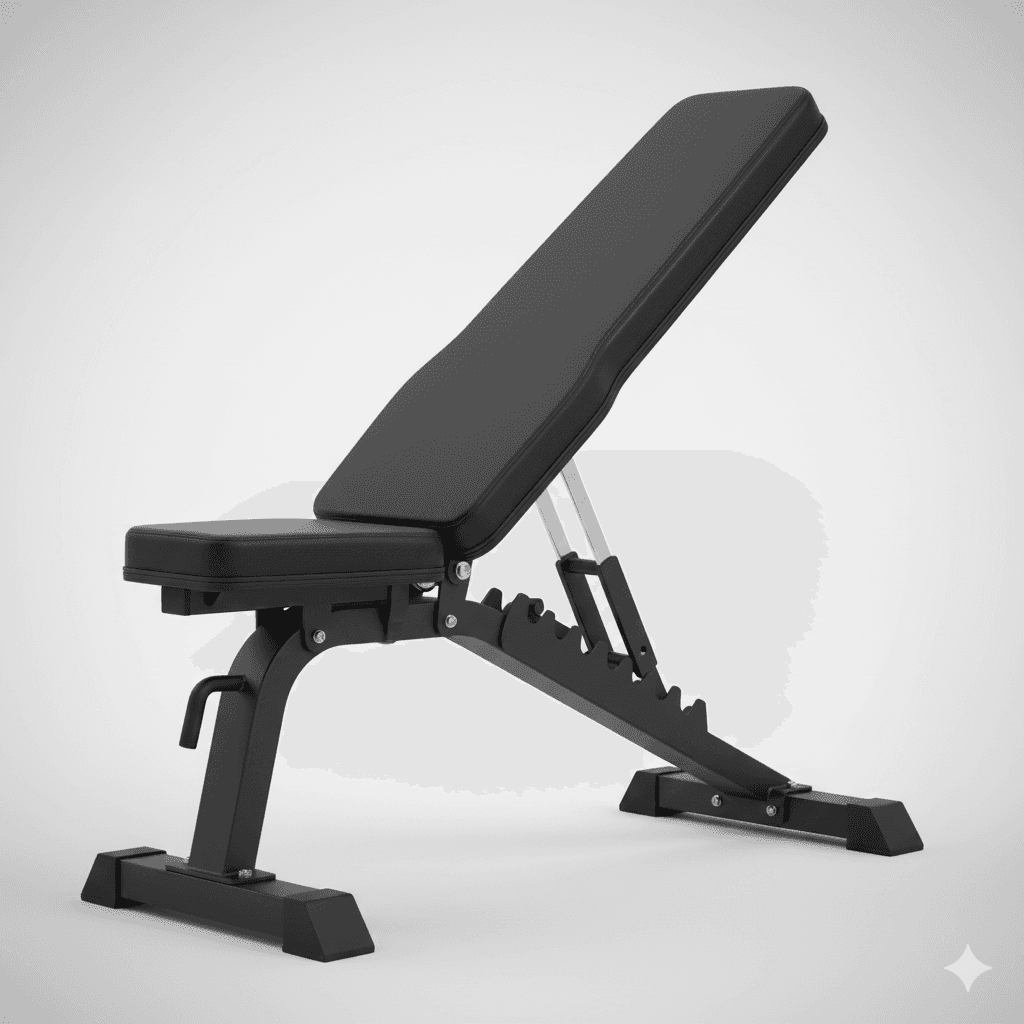
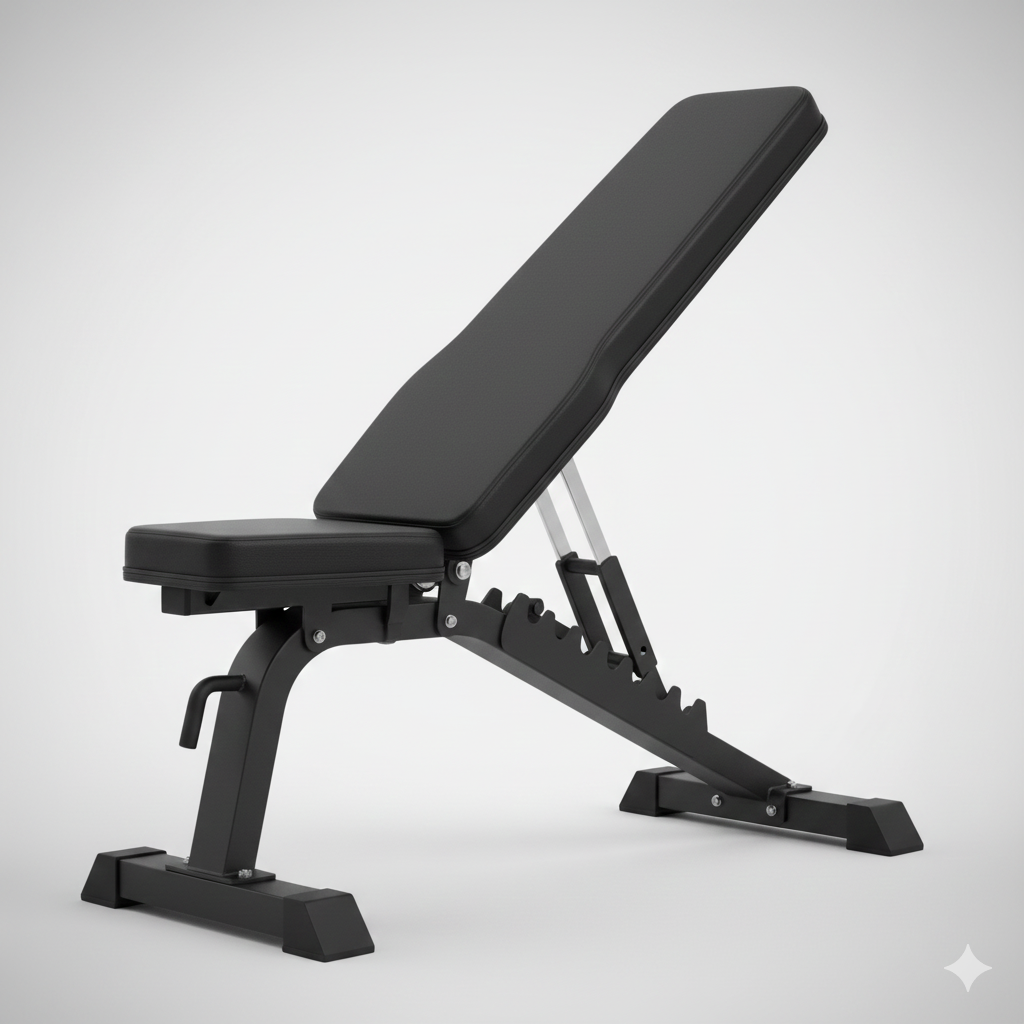
Adjustable bench (like the M150): Backrest adjusts through multiple angles from flat to fully upright. Covers incline press, shoulder press support, seated rows. This is what most home gym users need.
FID bench (Flat, Incline, Decline): Everything an adjustable does plus decline positions. The M460 is the prime example. Decline adds lower chest work and hanging ab exercises. Worth having if you're serious about chest development.
For most people: get an adjustable bench. The incline positions alone double your exercise variety. The step up to decline is useful but not essential at the start.
Why Adjustable Beats Flat
A flat bench does one thing. An adjustable bench does everything:
Incline press at 30-45° targets the upper chest - the part that actually shows in a fitted t-shirt. Flat pressing builds the middle, but neglecting incline is one of the most common mistakes in home training.
Shoulder press with back support takes pressure off your lower back compared to standing. You can go heavier and safer.
Seated rows with the bench at a low incline give back support for dumbbell rows without needing a cable machine.
Preacher curls using the bench pad. Tricep work. Step-ups. The list goes on.
The extra £50-60 for adjustability pays off almost immediately.
The Mirafit M150: Why It Dominates
The Mirafit M150 is the bench we'd recommend without hesitation. It's what most UK home gym communities settle on after trying alternatives. *(Price when reviewed: approximately £150 | Check Price on Amazon)*
Six backrest positions, four seat positions. The seat adjustment is what most benches skip - it lets you hold proper angle during incline pressing without sliding forward. Cheap benches don't have this and you feel it.
260kg weight capacity handles anything a home lifter will do. The 28kg construction weight is heavy enough that it doesn't rock or shift during loaded pressing. The pad density is firm (not soft) which is correct - soft padding compresses under load and makes pressing unstable.
The honest downsides: it's heavy to move. At 28kg it's not something you're casually relocating. And if you're only using 15kg dumbbells, you're paying for capacity you don't need - the foldable would serve you fine.
Budget Option: Mirafit Foldable
The Mirafit Foldable is the right starting point if you're not sure home training will stick, or if storage space is a genuine constraint. *(Price when reviewed: roughly £90 | Check Price on Amazon)*
It folds completely flat. Slides under a bed or stands behind a door. For dumbbell work up to 25-30kg per hand, it's stable enough. It adjusts through incline positions so you're not completely limited.
The honest tradeoff: lighter construction means detectable wobble under heavier loads. If you're pressing 35kg dumbbells or heavier, you'll feel it. At that point, the M150 is the correct tool.
Most people either outgrow this within 6-12 months or realise it's all they need for their training level. Buy it if you're starting out, upgrade if you progress.
Heavy Lifting: Mirafit M460 FID
For serious strength training, the Mirafit M460 FID adds decline positions and a leg attachment for leg curls and extensions. *(Price when reviewed: around £280 | Check Price on Amazon)*
350kg capacity handles competition-level lifters. The decline position works lower chest and allows hanging leg raises and declined crunches that aren't possible on a flat/incline bench.
Legs attachment adds leg curls and extensions - essentially two additional exercises from a bench accessory. If you're committed to a complete home gym without a separate leg machine, it's worth the premium.
Skip this if you're a beginner or intermediate. The M150 genuinely covers 95% of what most people ever need. The M460 is for people who know they want decline and leg work as permanent parts of their routine.
What Actually Matters When Buying
Weight capacity. Add your bodyweight to the maximum you'll ever lift. If you're 90kg and bench press 80kg, that's 170kg combined. Most decent benches handle 250kg+ which is fine. Go heavier if you plan to push serious loads. If you are not sure what your true maximum is, our one rep max calculator estimates it from any hard set of 2 to 12 reps.
The pad gap issue. Some benches have a gap between the seat pad and backrest pad. During heavy bench press when your lower back naturally arches slightly, this gap presses into your lower back. It's genuinely uncomfortable and ruins pressing sessions. Read the reviews specifically for this before buying.
Adjustment mechanism. Budget benches require you to hold the backrest up with one hand while pulling a pin with the other. Not a dealbreaker but annoying. Better benches use lever-operated ladders you can operate while seated. The M150 uses the ladder system.
Stability = weight. If a bench weighs under 15kg, it moves around during pressing. The M150 at 28kg stays put. The foldable at 14kg will shift under heavy load.
Backrest padding density. Firm is correct. Soft padding compresses under load and makes your pressing surface inconsistent. Press a hand into the pad - it should compress only slightly.
Exercises Unlocked by a Good Bench
Once you have a bench and adjustable dumbbells, here's what opens up:
Chest: - Flat dumbbell press (chest, triceps, front delts) - Incline press (upper chest emphasis) - Decline press (lower chest) - Dumbbell flyes (chest stretch)
Back: - Single-arm dumbbell rows (lat, rhomboid, rear delt) - Seal rows lying face-down (removes lower back from the equation) - Dumbbell pullovers (lats, serratus)
Shoulders: - Seated dumbbell press with back support - Incline lateral raises (rear delt)
Arms: - Incline dumbbell curls (full bicep stretch at bottom) - Tricep extensions seated or lying
Core: - Lying leg raises on a flat bench - Decline crunches (M460 only)
The bench is genuinely the second-highest impact purchase after the dumbbells themselves. It transforms a limited equipment setup into a complete upper body gym.
Bench Technique: The Basics That Matter
A bench is only useful if you use it correctly. The common mistakes that either reduce effectiveness or cause injury:
Bench press setup: Your shoulder blades should be squeezed together and down into the bench before you lift the bar. This creates a stable platform and protects the shoulder joint. If you press with rounded, elevated shoulders, you're loading a vulnerable position. The "arch" in bench press isn't about being dramatic - it's about retracting the shoulder blades properly.
Incline angle selection: Most people use too steep an incline for upper chest work. 30-45° is the target for upper chest. Above 60° shifts the load almost entirely to the front deltoid. The sweet spot on the M150 is the 30-45° notch, not the highest position.
Seat adjustment on incline pressing: The seat pad should be elevated when pressing at incline to prevent you from sliding towards the floor under load. This is the feature most benches omit and the M150 includes. Without it, heavy incline pressing becomes uncomfortable as you fight the slide.
Row position: For single-arm dumbbell rows with the bench for support, use the flat position with one knee and one hand on the bench. Keep your spine neutral, not rounded. Pull the dumbbell to your hip, not your shoulder. The elbow should travel close to your side, not flaring out.
Buying a Bench Secondhand
Benches hold up well secondhand. A used Mirafit M150 on Facebook Marketplace is excellent value if it passes inspection.
What to check: - Pad condition: Press across the whole surface firmly. Lumps indicate foam breakdown - fine on the seat pad, problematic on the backrest where you're pressing. A sunken backrest means your pressing surface is inconsistent. - Frame welds: Check all weld points, especially the hinge points on adjustable benches. Surface rust is cosmetic. Cracked, porous, or clearly repaired welds indicate structural weakness. - Adjustment mechanism: Work through every angle position. Pins should click firmly and not slip under load. Worn ladder rungs cause position drift during pressing. - Stability test: Sit on the bench and push it sideways. Any rack or wobble in the frame indicates bent or damaged structure. A solid bench is completely rigid.
The Mirafit brand retains value well because buyers trust it. Cheaper no-name benches rarely appear secondhand - nobody wants them enough to buy used.
What to Avoid
Cheap no-name benches under £60. At this price, the construction quality is consistently poor. Welds fail at stress points. Vinyl tears within months. The adjustment mechanisms strip or stick. The weight capacity ratings are aspirational, not tested. Wobble under heavy pressing creates instability that reduces strength output and is a genuine safety concern.
Benches without seat adjustment. When you press at incline, gravity pushes you towards the floor. Without a seat pad that elevates to hold you in position, you either slide down during the set or brace inefficiently to resist it. This matters more as the weights get heavier. The M150 solves it; most budget alternatives don't.
A decline bench as your first purchase. Decline chest work is a nice-to-have, not a training fundamental. The incline angle develops the upper chest that actually shows in everyday clothes. Many experienced lifters rarely decline press. Buy the standard adjustable bench first - you can add decline capability later if you discover you specifically want it.
Soft padding. Counterintuitively, a bench with plush, comfortable-feeling padding is worse for pressing. Soft foam compresses under load and makes your pressing surface change position during the set. You want a firm pad that doesn't deform significantly. The right test: press your hand into the pad with reasonable force. It should give slightly, but not compress more than 10-15mm.
Flat benches for a complete setup. A flat bench does one thing. An adjustable bench does six things. Unless you specifically want the rigidity of a fixed flat bench for very heavy barbell pressing (where a flat bench can be more stable), the incline positions on an adjustable bench more than compensate for any marginal stability difference.
Frequently Asked Questions
What width bench fits inside a power rack? Most UK power racks have an internal width of 55-70cm. The Mirafit M150 is 51cm wide - it fits inside the M1 rack with room to spare. The M460 is slightly wider. Always cross-check your specific rack's internal clearance against the bench width before buying.
Can we use a bench for barbell bench press without a rack? Not safely. Without safety bars to catch a failed lift, you're limited to weights you can comfortably dump to one side, which means you can never push to genuine failure. A bench paired with a power rack is the correct setup for barbell pressing alone.
Is a 150kg capacity bench enough? The foldable bench is rated 150kg. Your bodyweight plus the weights you're pressing plus dynamic loading determines the relevant load. If you weigh 80kg and are pressing 30kg dumbbells (60kg total), you're at 140kg - right at the limit. For peace of mind beyond this, the M150 at 260kg capacity gives significant headroom.
How much floor space does a bench need? An adjustable bench is typically 1.2m long by 0.5m wide, plus 1m each side for lying down and standing. A usable bench pressing area needs roughly 2m x 2m - allow room to pick the dumbbells up from the floor and step back before sitting. The foldable bench shrinks to 15cm depth when stored, which makes the real-world space impact manageable in a small room.
Should I buy a preacher curl attachment? Not as a first purchase. A preacher curl attachment bolts onto many adjustable benches and allows isolated bicep work with the upper arm supported. It's a useful accessory once you've been training consistently for several months and want to prioritise arm development specifically. Before that, incline dumbbell curls on the adjusted bench give a comparable stretch without the extra purchase.
Full Comparison
| Feature | Mirafit Foldable | Mirafit M150 | Mirafit M460 FID |
|---|---|---|---|
| Price | roughly £90 | roughly £150 | roughly £280 |
| Capacity | 150kg | 260kg | 350kg |
| Weight | 14kg | 28kg | 35kg |
| Positions | Flat + 3 incline | 6 backrest + 4 seat | 7 positions + decline |
| Leg attachment | No | No | Yes |
| Folds | Yes | No | No |
| Best For | Beginners, small spaces | Most home gym users | Serious strength training |
Buying Used
Good benches hold up. An Mirafit M150 bought second-hand on Facebook Marketplace is a smart purchase. What to check:
- Pad condition: Press across the whole surface. Lumps and hard spots mean the foam has broken down. Fine on the body pad, a problem on the backrest where you're pressing. - Weld integrity: Check the leg welds and pivot points. Minor surface rust is cosmetic. Cracked or porous welds are structural. - Adjustment function: Work through every position. Worn or bent ladder pins stick. Mechanism should click cleanly into each position. - Wobble test: Stand on the bench. Any flex or rock indicates bent or weak frame. Fine for light dumbbell work, not for heavy pressing.
Bench Angles and Exercise Selection
Most adjustable benches offer flat, 30-degree, 45-degree, and 60-degree incline positions. Some add a decline option. Each angle targets different muscle groups.
Flat (0 degrees): The standard position for bench press, which primarily works the middle chest, front deltoids, and triceps. Also used for dumbbell rows, lying tricep extensions, and hip thrusts.
30-degree incline: The most useful incline position. Targets the upper chest and front deltoids with less shoulder strain than steeper angles. Most strength coaches recommend this as the default incline position for general training.
45-degree incline: Shifts more work to the front deltoids at the expense of chest activation. Useful for shoulder press when combined with a back support and for incline dumbbell curls.
60-degree incline: Essentially a seated position. Used for overhead press, seated shoulder work, and supported dumbbell curls. Reduces lower back strain compared to standing variations.
Decline (-15 to -20 degrees): Targets the lower chest. Studies show decline bench press activates the lower pectoral fibres more effectively than flat bench. However, decline benches are less versatile and the angle makes heavy lifting feel unstable without a training partner. Most home trainers skip decline because dips hit the same muscles more naturally.
Weight Capacity and Real-World Safety
Every bench in this guide lists a weight capacity. This number includes both the weight on the bar and your body weight.
A bench rated at 300kg supports a 90kg person pressing 210kg, which is more than most people will ever achieve. A bench rated at 200kg supports a 90kg person pressing 110kg, which is genuinely limiting for intermediate lifters who progress to 100kg+ bench press within 1-2 years of consistent training.
Buy more capacity than you think you need. A bench rated at 300kg feels solid at 100kg. A bench rated at 200kg flexes noticeably at 100kg. The flex is not dangerous, but it reduces confidence under heavy loads, and confidence matters when you have a barbell above your face.
Stability indicators beyond the weight rating: wide base feet (ideally 3 or more support points), rubber feet that grip the floor, and no lateral wobble when you push the backrest sideways. Test this in the shop if possible. If buying online, check reviews specifically mentioning stability under load, not just the rating.
Upholstery and Pad Quality
The vinyl covering on a weight bench takes enormous abuse. Sweat, friction from clothing, chalk dust, and repeated compression from body weight and barbell contact all degrade the surface.
Cheap vinyl (found on benches under £80) cracks and peels within 12-18 months of regular use. The foam underneath compresses permanently, creating dips where your back contacts the pad. This is more than aesthetic: uneven padding reduces support during heavy pressing and can cause back discomfort.
Quality vinyl with high-density foam maintains its shape for 3-5 years. The Mirafit M150 and Strengthshop benches use thicker vinyl and denser foam than budget alternatives. The padding is firm enough to support heavy loads without compressing, yet comfortable enough for extended sessions.
Our Recommendation
Get the Mirafit M150. It's the bench most UK home gym users end up with, and most wish they'd bought it first rather than after a cheaper bench disappointed them. 260kg capacity, 6 angles, UK brand, built properly. *(approximately £150 | Check Price on Amazon)*
Start with the foldable only if storage is a real constraint and you're testing the home gym concept before committing. The M460 is worth it once you've been training consistently for 6+ months and know decline work is something you want.
The Mirafit M150 is the bench most UK home gym users settle on after trying a cheaper one first. Skip the cheaper one. The £150 you spend once beats replacing an £80 bench that disappoints you inside a year.
Once you have the bench and a pair of adjustable dumbbells, your home gym is functional for most training goals. The optional additions - pull-up bar, resistance bands, kettlebell - build on that foundation progressively. See our best home gym equipment guide for the full buying sequence from first purchase to complete setup, and our home gym on a budget guide if you need to keep the total spend under £500. Both routes start with a bench and dumbbells, because that combination covers more effective exercises than any other £400-500 investment you can make in home training equipment.
As an Amazon Associate, we earn from qualifying purchases.
Products Mentioned in This Guide
Frequently Asked Questions
Related Guides
Find Your Perfect Equipment
Expert guides for racks, barbells, plates, benches, and more. Build your home gym the right way.
Browse All Guides