Best Home Gym Flooring UK 2026

Thirty years of training at home. Built multiple home gyms from bare garages to proper setups. I know what equipment lasts, what breaks, and what becomes an expensive clothes rack.
Just so you know, some links on this page are affiliate links. If you buy something via them, we get a small kickback. You don't pay more, but it helps toward the next bit of kit.
Looking for more equipment recommendations?
Browse All GuidesGym flooring is the one purchase that makes every other piece of equipment work better. It protects your floor, deadens impact noise, stops equipment shifting mid-set, and makes the space feel like a gym rather than a spare room you dropped some weights in.
The good news: it is one of the cheapest problems to solve if you buy the right type for how you actually train.
Quick Picks
| Use Case | Pick |
|---|---|
| Yoga, cardio, bodyweight | Top Home Solutions EVA Tiles |
| Mixed training, dumbbells | AIRHOP ACTIVE Rubber-Top Tiles |
| Barbells, power rack, heavy drops | Rubber Crumb Tiles 10mm |
---
The Three Types of Home Gym Flooring
Getting confused by the options is understandable - the difference between them matters a lot in practice.
EVA foam tiles are lightweight interlocking puzzle tiles made from foam. Good for cushioning, easy to install, cheap per square metre. Not suitable for dropping weights or placing heavy equipment with small contact points (rack footplates, barbell plates).
Rubber-top hybrid tiles have an EVA foam base with a textured rubber surface layer. Better grip, better durability, more resistant to damage from dumbbell drops. The mid-range choice for general home gym use.
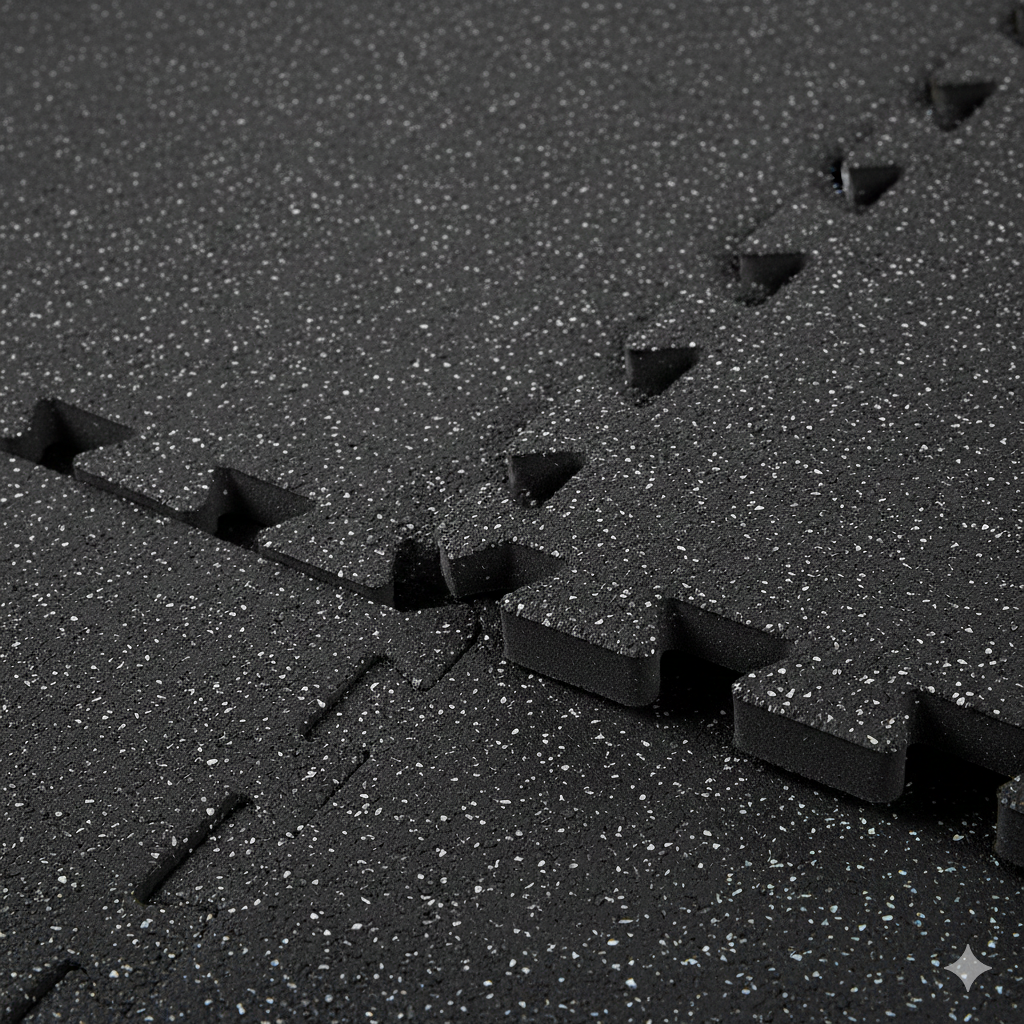
Rubber crumb tiles are made from recycled rubber - the same material used in commercial gym floors. Heavy, dense, and built to absorb impact from real weights. The only sensible choice under a power rack, deadlift platform, or anywhere you are dropping loaded barbells.
---
Budget Option: Top Home Solutions EVA Foam Tiles
For yoga, stretching, cardio equipment, and bodyweight training, EVA foam tiles are perfectly adequate. The Top Home Solutions 24-pack covers 8.6m² at 10mm thickness - enough for a decent training area at around £50.
The puzzle-lock edges fit together cleanly and the set includes border pieces for finished edges rather than raw puzzle tabs. You can cut tiles with a utility knife to fit around walls or equipment.
Where it falls apart: Anything involving heavy static loads or dropped weights. Foam compresses and deforms under rack footplates. A dropped dumbbell from knee height will dent 10mm EVA. This is not a limitation of budget, even expensive EVA foam tiles cannot handle this. If your training includes weights, step up to rubber.
Best for: Dedicated yoga or stretching area, cardio equipment zone (treadmill, bike, rowing machine footprint), living room workouts where you need protection for the carpet.
---
Mid-Range: AIRHOP ACTIVE Rubber-Top Tiles
The rubber-top hybrid is the right choice for most home gym users who do a mix of training - some bodyweight and mobility work, some dumbbell training, maybe kettlebells. The rubber surface layer handles moderate dumbbell drops (from floor height or low bench height) and grips equipment feet to stop them sliding.
The AIRHOP tiles are 14mm total - thin enough to feel stable underfoot and thick enough to absorb most gym use. The six-tile pack covers 2.2m², which is roughly a personal training zone or one equipment footprint. Buy two or three packs to cover a full room.
At approximately £25 per m², this is more expensive than EVA foam but significantly cheaper than commercial rubber crumb tiles for general use.
Best for: Dumbbell training area, kettlebell work, areas where you need grip and moderate protection. Anyone combining bodyweight and light-to-moderate weight training.
Not for: Power rack, deadlifts, or anything involving dropping loaded barbells. The foam base underneath the rubber layer is not built for that.
---
Heavy Duty: Rubber Crumb Tiles
If you have a power rack, you are dropping deadlifts from waist height, or you have a barbell that ever leaves the floor loaded - rubber crumb is the only flooring worth buying for that zone.
The Ark Mat tiles are 1m x 1m, 10mm thick, at around £25 per tile. For the footprint directly under a power rack (roughly 1.5m x 1.5m), budget for four tiles. For a full 3x3m training area, budget around £225 for nine tiles.
10mm handles moderate use well. Step up to 20-25mm if you are regularly dropping heavy deadlifts (120kg+) - the thicker material absorbs the impact load over a larger area. The 25mm version (B0CKW72G5K) is around £55 per tile.
The weight consideration: Each 1m² rubber crumb tile weighs approximately 15-20kg at 10mm. This is fine for a permanent garage gym. It is not practical flooring for a room you need to return to normal use. For semi-permanent installs, the tiles interlock without adhesive and can be pulled up, but it takes two people and some effort.
Best for: Power rack footprint, barbell training area, anywhere you are loading and potentially dropping weights. The most durable option for long-term serious use.
---
Coverage Calculator
| Room Size | m² | EVA Cost (roughly £6/m²) | Rubber-Top Cost (roughly £25/m²) | Rubber Crumb 10mm (roughly £25/m²) |
|---|---|---|---|---|
| 3m x 3m | 9m² | roughly £54 | roughly £225 | roughly £225 |
| 3m x 4m | 12m² | roughly £72 | roughly £300 | roughly £300 |
| 4m x 4m | 16m² | roughly £96 | roughly £400 | roughly £400 |
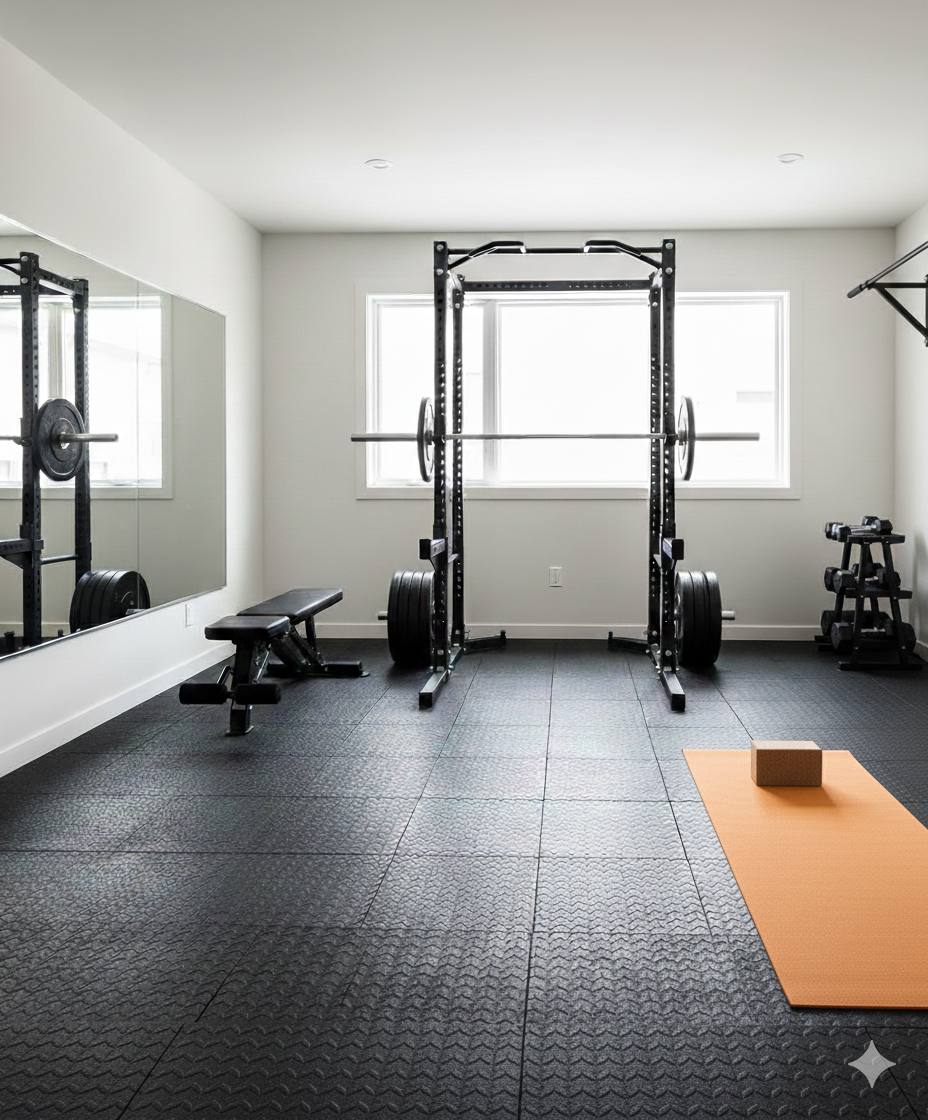
For most home gyms the smart approach is to mix: rubber crumb under heavy equipment (rack, deadlift zone), rubber-top or EVA for the rest of the floor. This keeps cost down while protecting where it matters.
---
What to Skip
Yoga mats as gym flooring: A single yoga mat is 60cm wide. You need continuous coverage. Yoga mats also slide on hard floors under load. Not a substitute.
Carpet tiles: They absorb sweat, are very difficult to clean properly, and provide poor grip stability for equipment. Avoid in a dedicated gym space.
Very thin foam tiles (5mm and under): These exist and are cheap, but they provide almost no protection for the floor or your joints. Minimum 10mm for any real gym use.
---
Our Recommendation
For a full home gym setup, the practical approach is to layer:
- Rubber crumb under the rack and deadlift zone (where weight hits the floor) - Rubber-top hybrid tiles for the rest of the training area - EVA foam in any mobility/cardio-only zone
If budget is tight and you are starting out with dumbbells and no barbell, the AIRHOP rubber-top tiles for your main training zone is the right starting point. Upgrade the rubber crumb zone when you add a rack.
Lay the flooring before you bring in the equipment. Every home gym builder who skipped this step has regretted moving a loaded rack to get matting underneath it.
---
The Practical Impact: What Good Flooring Actually Does
Gym flooring is not cosmetic. The right flooring directly impacts how long your equipment survives, how safe your training is, and whether the gym disrupts the rest of your life.
Joint protection: A loaded barbell drop from waist height transfers roughly 2-3x bodyweight impact into the floor. Thin foam or carpet cannot absorb this - the impact goes into concrete, bounces back up through your body, and into your knees, hips, and spine. Rubber crumb absorbs the shock and deadens it. You feel the difference in your joints immediately.
Equipment longevity: Flooring protects the bar, plates, and rack feet from damage. Without protection, plates develop flat spots from dropped weight, bar sleeves develop dents that slow rotation, and rack feet indent into concrete. A full barbell setup costs £300-500. Protecting it with £150 of flooring is elementary economics.
Noise control: A 100kg deadlift drop onto bare concrete is loud enough to disturb housemates or neighbours. Rubber crumb reduces that by roughly 70%. This is not negotiable if you train anywhere other than a detached garage. This alone is worth the cost.
Equipment stability: Dumbbells, kettlebells, and barbells all shift on hard smooth floors under load. Rubber-top and crumb tiles grip equipment feet and prevent sliding mid-lift. This is a safety issue, not just convenience.
---
Flooring Strategy for Your Training Style
The mistake most people make is buying one type of flooring and trying to use it everywhere.
If you train with dumbbells and bodyweight only: Rubber-top hybrid tiles everywhere. Budget £300-400 for a 12-16m² training zone. This covers all your impacts and gives you a defined training area.
If you have a power rack and do barbells: Rubber crumb under the rack footprint (roughly 1.5x1.5m = 4 tiles, around £100) and rubber-top hybrid for the rest of the zone. Total investment approximately £300-400 depending on room size. This gives you maximum protection where it matters most and keeps cost reasonable everywhere else.
If you have limited space (small bedroom or flat): Start with rubber-top hybrid tiles only. A 2x2m zone with AIRHOP tiles costs roughly £100 and covers most training styles. If you add a rack later, add crumb tiles under it then. Hybrid tiles are not perfect under heavy loads, but they are adequate if you are not regularly dropping 100kg+ deadlifts.
If you train cardio (treadmill, rowing machine): EVA foam tiles in that zone only. Cardio equipment needs cushioning for joint protection, and EVA is ideal. You don't need expensive rubber for constant-impact machines.
---
Common Questions About Gym Flooring
Q: How much flooring do I actually need? Most home gym users train in 8-12m². A single 3x3m room covers this completely. If you have two zones (heavy equipment zone + cardio area), 16m² is realistic. Calculate by room dimensions first, then decide which material for each zone.
Q: Do I need to glue the tiles down? No. Rubber crumb and rubber-top tiles interlock without adhesive. Interlocking is sufficient for home use. Gluing only matters for commercial gyms with constant foot traffic. Leave them unglued so you can pull up and move tiles if you rearrange equipment.
Q: Can I put flooring over carpet? No. Flooring needs a hard flat surface (concrete or wood). Over carpet, tiles shift and the floor underneath compresses unevenly. Remove the carpet first, or put flooring on the concrete underneath if you have basement access.
Q: Will rubber crumb smell bad? New rubber tiles have a slight rubber smell for 1-2 weeks. Open windows and ventilate. The smell disappears completely. Rubber crumb does not release harmful fumes - it is the same material used in commercial gyms, playgrounds, and running track surfaces. Standard safety.
Q: How long until I need to replace flooring? Rubber crumb tiles last 10-15 years in home gym use. Rubber-top hybrid tiles last 8-10 years. EVA foam lasts 5-7 years and degrades faster if exposed to direct sunlight. By the time you need replacement, the cost per year of use is negligible.
Q: Should we use different thickness flooring? For home use, 10mm is standard and sufficient. Step up to 20mm only if you regularly drop loaded barbells (120kg+) from chest or overhead height. Most people drop from below waist height, where 10mm is adequate. Thicker is heavier to move and more expensive with no practical benefit for most training.
---
Long-Term Flooring Maintenance
Rubber gym flooring requires minimal care. Sweep weekly to prevent grit accumulating in the interlocking joints. Mop monthly with warm water and a mild detergent. Avoid bleach-based cleaners that degrade rubber over time. For stubborn chalk marks, a stiff brush with soapy water removes them without damaging the surface.
Installation: DIY vs Professional
Gym flooring installation is a straightforward DIY project. Interlocking rubber tiles require no tools, no adhesive, and no special skills. Measure the area, order 10% more tiles than the measured area (to account for cuts around edges and obstacles), and lay from one corner outward.
Flooring Types Compared
The UK market has four main types of gym flooring, each with distinct advantages.
Rubber tiles (20mm, interlocking) are the default recommendation. They absorb impact, reduce noise, protect sub-floors, and interlock without adhesive. A 2x2 metre area costs around £60-80 for quality tiles. The interlocking mechanism means no gaps appear over time, and individual damaged tiles can be replaced without lifting the entire floor.
Rubber rolls (6-10mm) are cheaper per square metre but harder to install. They curl at edges, slide on smooth floors, and cannot be replaced in sections. Suitable for light use (yoga, bodyweight training, light dumbbells) but insufficient for heavy lifting or equipment that shifts under load.
EVA foam tiles are lightweight and comfortable underfoot. Popular for martial arts and bodyweight training. However, they compress permanently under heavy equipment, dent easily from dropped weights, and provide poor stability for bench press and squat setups. Not recommended for strength training.
Garage Floor Considerations
UK garages present specific flooring challenges that spare bedrooms do not.
Cold concrete in winter drops below 10 degrees Celsius in most UK garages. Training barefoot or in thin-soled shoes on cold concrete is genuinely unpleasant and reduces grip confidence during heavy lifts. Rubber flooring adds thermal insulation. A 20mm rubber tile on concrete raises the surface temperature to comfortable levels within minutes of entering the garage.
Damp is the enemy. UK garages frequently suffer from condensation, especially in autumn and winter when temperature differentials between inside and outside are greatest. Moisture trapped between flooring and concrete breeds mould. The solution: leave a 5mm gap around the perimeter of your flooring and use tiles rather than rolled rubber so moisture can evaporate. Never glue gym flooring directly to a concrete garage floor unless you have confirmed the floor has a damp-proof membrane.
Uneven surfaces are common in older UK garages where the concrete has cracked or settled. Thin rubber matting (10mm or less) conforms to surface irregularities and feels uneven underfoot. Thicker tiles (20mm+) bridge small gaps and cracks. For significantly uneven floors, self-levelling compound (around £20-30 per bag, one bag covers approximately 5 square metres at 3mm depth) creates a flat base before laying flooring.
Vehicle access. If you share the garage with a car, you need flooring that can be moved or withstands tyre pressure. Interlocking tiles are ideal because they can be lifted in sections. Rolled rubber tends to be driven over repeatedly and develops permanent tyre tracks.
Noise Reduction for Upstairs and Shared Walls
Deadlifts, dropped dumbbells, and barbell returns generate impact noise that travels through floors and walls. In a detached house with a ground-floor gym, this is rarely problematic. In a flat, terraced house, or upper-floor room, noise transmission determines whether your neighbours tolerate your training.
Impact noise reduction is measured in decibels. A bare concrete or wooden floor transmits approximately 70-80dB from a moderate dumbbell drop. Adding 20mm of rubber reduces this to 55-65dB. Adding a 20mm rubber tile on top of a 10mm foam underlayer reduces it further to 45-55dB. For comparison, normal conversation is 60dB. Below 50dB, impact noise from the floor above is barely perceptible.
Deadlift platforms provide maximum noise protection in a small area. A 1.2m by 2.4m platform consisting of two layers of 18mm plywood topped with 20mm rubber tiles absorbs the majority of impact from barbell drops. Cost: approximately £80-120 depending on rubber quality. This is the standard approach in home gyms where deadlifts are trained regularly.
What to Avoid
EVA foam tiles for heavy lifting areas. Foam puzzle tiles (the colourful interlocking mats sold for children's playrooms) compress permanently under heavy loads. A power rack leg will sink through 12mm EVA foam within weeks, creating an uneven surface. Foam tiles are fine for bodyweight exercise areas and stretching zones, but anywhere a rack stands or weights are dropped needs rubber.
Carpet remnants as gym flooring. Carpet feels soft underfoot but creates instability during heavy lifts. Your feet shift subtly on carpet pile, reducing power transfer and increasing injury risk during squats and deadlifts. Carpet also traps sweat, breeds bacteria, and becomes impossible to clean properly. Remove carpet from the training area entirely.
Thin rubber mats (under 12mm) in upstairs rooms. A 6mm rubber mat protects the floor surface from scuffs but does almost nothing for impact absorption or sound transmission. For upstairs training, 15-20mm rubber is the minimum for dumbbell work. For any barbell training above ground floor, 20mm rubber over 12mm plywood is the standard approach for protecting the floor structure.
Gluing tiles directly to concrete without checking moisture. UK garages frequently have damp concrete, especially in older properties without a damp proof membrane. Moisture trapped under glued rubber tiles causes mould growth that you cannot see until the smell becomes obvious. Lay tiles loose or use interlocking rubber, and check for moisture with a plastic sheet taped to the concrete for 48 hours before committing to adhesive.
Building Your Setup: The Flooring-First Approach
The single biggest mistake home gym builders make: they buy equipment first, then realise they need flooring and have nowhere to put it.
Reverse the order. Here's the sequence:
1. Measure your space (length, width, ceiling height, obstacles) 2. Decide your training style (power rack and barbells, dumbbells only, mixed, cardio-first) 3. Specify flooring (crumb under heavy zones, hybrid elsewhere) 4. Lay flooring (takes 30-60 minutes, no tools needed) 5. Then bring in equipment (now you have a safe, protected surface ready to go)
This approach solves three problems at once: your floor is protected from day one, your equipment sits on a stable surface, and you don't discover halfway through setup that you have nowhere to put the flooring.
The small investment in upfront planning saves frustration, protects your equipment, and keeps your joints safer from impact shock. You will use this flooring for every training session for the next 10 years. The £200-300 investment amortises to less than 10p per training session.
Good flooring is infrastructure, not an upgrade. Build it first, train harder on it for years.
As an Amazon Associate, we earn from qualifying purchases.
Products Mentioned in This Guide
Frequently Asked Questions
Related Guides
Find Your Perfect Equipment
Expert guides for racks, barbells, plates, benches, and more. Build your home gym the right way.
Browse All Guides